Posts

Showing posts with the label Burdinbidearen Euskal Museoa

Ferrocarriles Vascongados 104 – Nasmyth, Wilson and Co.

Image
Steam locomotive formerly operated by Ferrocarriles Vascongados seen at the premises of the Basque Railway Museum in Azpeitia in October 2008. This tank locomotive with fleet number ESS 14 and named "Aurrerá" is built by Nasmyth, Wilson & Co. Ltd. in 1898, construction number 551, and placed in service by the Compañía del Ferrocarril de Elgoibar a San Sebastián. In 1906, the merger of this operator with two others, the Compañía del Ferrocarril Central de Vizcaya and the Compañía del Ferrocarril de Durango a Zumárraga, gave rise to the Compañía de los Ferrocarriles Vascongados. From then on, this locomotive acquired the identity of FV 104 "Aurrerá" , remaining active until the 1960s. Overall length (buffers) is 27.1 ft. Two cylinders transmit motion to six driving wheels. Nominal output is 190 kW (250 hp). Weight in service is 35 t. Wheelset arrangement is 2-6-0T or 1'C 2t and gauge is 3 ft 3+3⁄8 in. This locomotive was used for both passenger and freigh...

Ferrocarril de La Robla 207 – SECN

Image
Diesel-hydraulic locomotive formerly operated by Ferrocarril de La Robla seen at the premises of the Basque Railway Museum in Azpeitia in October 2008. This diesel-hydraulic locomotive with fleet number 207 is built under license from the Yorkshire Engine Company (YEC) ¹ by the Sociedad Española de Construcción Naval (SECN) in 1965, included in a series of 8 units (FR 201–208) placed in service by the Ferrocarril de La Robla in 1966–1967. Overall length (buffers) is 23.4 ft. This diesel-hydraulic locomotive uses a 161 kW (219 hp) Rolls Royce C6 TFL "L6" diesel engine. Weight in service is 33.5 t. Wheelset arrangement is C  ²  (wheels with coupling rods) and gauge is 3 ft 3+3⁄8 in. Top speed is approximately 19 mph. This switcher (or shunter locomotive) was occasionally used in light freight and passenger services. Between 1965 and 1967, SECN supplied 29 of these units to six Spanish operators. Here, in October 2008, we find FR 207, retired in 1990 as FEVE 1324, stretch...

Euskotren 214 – CAF

Image
Electric multiple unit operated by Euskotren  seen at Amara–Donostia  station  ¹  in October 2008. This electric multiple unit with fleet number 214 ² is built by CAF / Babcock & Wilcox / Westinghouse ³ , included in a series of 20 triple units placed in service by Euskotren betwen 1986 and 2000. Between 1996 and 2000, they became quadruple units, with the addition of a second intermediate trailer. With an overall length (couplers) of 225.8 ft, they can accommodate 386 passengers (260 seated passengers). Equipped with two pantographs and fed by 1500 V DC, this electric multiple unit uses four GEE 326 G-1 traction motors in the motor units, one per bogie. Nominal output is 960 kW (1290 hp). Weight in service is 120 t. Wheelset arrangement is Bo'Bo'+2'2'+2'2'+Bo'Bo' and gauge is 3 ft 3+3⁄8 in. Top speed is 50 mph. Initially intended for metropolitan services on the Bilbao–Plentzia and Bilbao–Lezama lines, these units were transferred from 1995 to s...

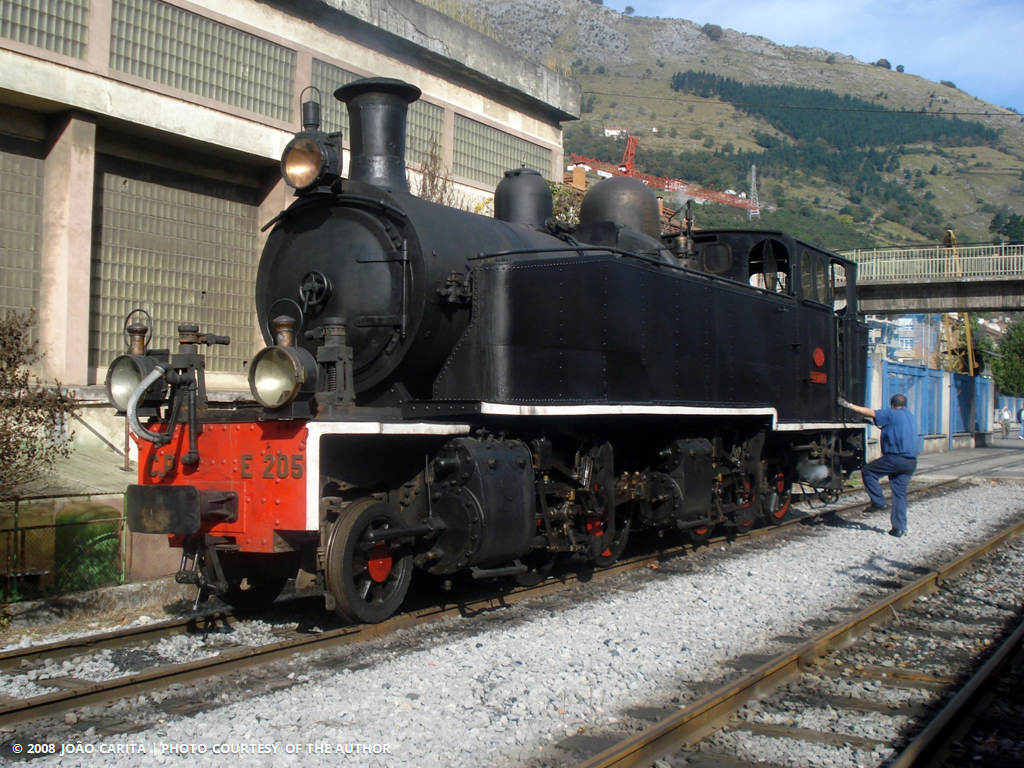
CP E 205 – Henschel & Sohn

Image
Steam locomotive formerly operated by CP seen at the premises of the Basque Railway Museum in Azpeitia in October 2008. This steam locomotive with fleet number CP E 205 is a Henschel & Sohn build, construction number 12280 (1913), included in a series of 16 units placed in service in 1911–1923. Overall length (buffers) is 39.7 ft. It has a heating surface of 123,30 m² and a grate area of 1,96 m². Four cylinders, two high pressure (⌀ 350x550 mm) and two low pressure (⌀ 500x550 mm), transmit motion to ten driving wheels (⌀ 43.3 in). Tractive effort is 77 kN (7875 kg). Weight in service is 60 t. Wheelset arrangement is 2-4-6-0T or (1B')C n4vt  ¹  and gauge is 3 ft 3+3⁄8 in. I think the top speed will  be approximately 25 mph. This Mallet -type semi-articulated tank locomotive, with a " compound " system, built by Henschel & Sohn, and whose maximum axle load does not exceed 10600 kg, was capable of maintaining high levels of traction on sinuous routes. It was used i...