Images and brief descriptions of transportation vehicles mostly in Lisboa, Portugal.
Carris Metropolitana – ALSA Todi 12719 – Yutong E9
Get link
Facebook
X
Pinterest
Email
Other Apps
Electric bus operated by Carris Metropolitana – ALSA Todi seen at Terminal Rodoviário de Palmela in February 2023. This electric bus with fleet number 12719 is a Yutong E9 (or Yutong ZK6890BEVG) registered in 2022. It has an overall length of 29.3 ft and can accommodate 21 seated passengers, 41/35 standees and 0/1 passenger with reduced mobility (21+41+1 or 21+35+1PMR+1). It features a self-supporting structure, air suspension and uses the 125 kW (170 hp) Yutong TZ400XSYTB44 permanent magnet synchronous electric motor powered by a lithium-iron phosphate battery. Established in 2022, Carris Metropolitana – ALSA Todi ¹ operates since 2022 regular services in the municipalities of Alcochete, Montijo, Moita, Palmela and Setúbal and provides connections to Barreiro and Lisboa. It also offers specialized regular services and occasional services. The fleet displays the yellow paint scheme common to the four operational areas of Carris Metropolitana. Here, we see this eye-catching Yutong ² E9 taking a short break at the Palmela Bus Terminal. ●
Autocarro eléctrico operado pela Carris Metropolitana – ALSA Todi visto no Terminal Rodoviário de Palmela em Fevereiro de 2023. Este autocarro eléctrico com o número de frota 12719 é um Yutong E9 (ou Yutong ZK6890BEVG) registado em 2022. Tem um comprimento total de 8,94 m e pode acomodar 21 passageiros sentados, 41/35 de pé e 0/1 passageiro com mobilidade reduzida (21+41+1 ou 21+35+1PMR+1). Possui estrutura autoportante, suspensão pneumática e utiliza o motor eléctrico síncrono de íman permanente Yutong TZ400XSYTB44 de 125 kW (170 hp) alimentado por uma bateria de fosfato de lítio-ferro. Estabelecida em 2022, a Carris Metropolitana – ALSA Todi ¹ opera desde 2022 serviços regulares nos municípios de Alcochete, Montijo, Moita, Palmela e Setúbal e assegura ligações ao Barreiro e a Lisboa. Disponibiliza também serviços regulares especializados e serviços ocasionais. A frota exibe o esquema de pintura em amarelo, comum às quatro áreas operacionais da Carris Metropolitana. Aqui, vemos este apelativo Yutong ² E9 durante uma curta pausa no Terminal Rodoviário de Palmela. ●
¹ ALSA Todi is the result of a partnership between the Spanish operator ALSA, part of the National Express group, and the Portuguese operator Luísa Todi, based in Setúbal and part of the Spanish group Transvia, to provide public service in the Área Metropolitana de Lisboa (Área 4, the metropolitan sector of operation). Public service in Área 4 begins on June 1, 2022, under the "Carris Metropolitana – ALSA Todi" brand. ● A ALSA Todi resulta da parceria entre o operador espanhol ALSA, parte do grupo National Express, e operador português Luísa Todi, baseado em Setúbal e parte do grupo espanhol Transvia, para prestar o serviço público na Área Metropolitana de Lisboa (Área 4). O início do serviço público na Área 4 tem lugar em 1 de Junho de 2022, sob a marca "Carris Metropolitana – ALSA Todi".
² 郑州宇通客车股份有限公司 (Zhengzhou Yutong Bus Co., Ltd.), Zhengzhou, China
Carris Metropolitana – ALSA Todi
Carris Metropolitana – ALSA Todi operates regular services in the municipalities of Alcochete, Montijo, Moita, Palmela and Setúbal and provides connections to Barreiro and Lisboa. It also offers specialized regular services and occasional services. ●
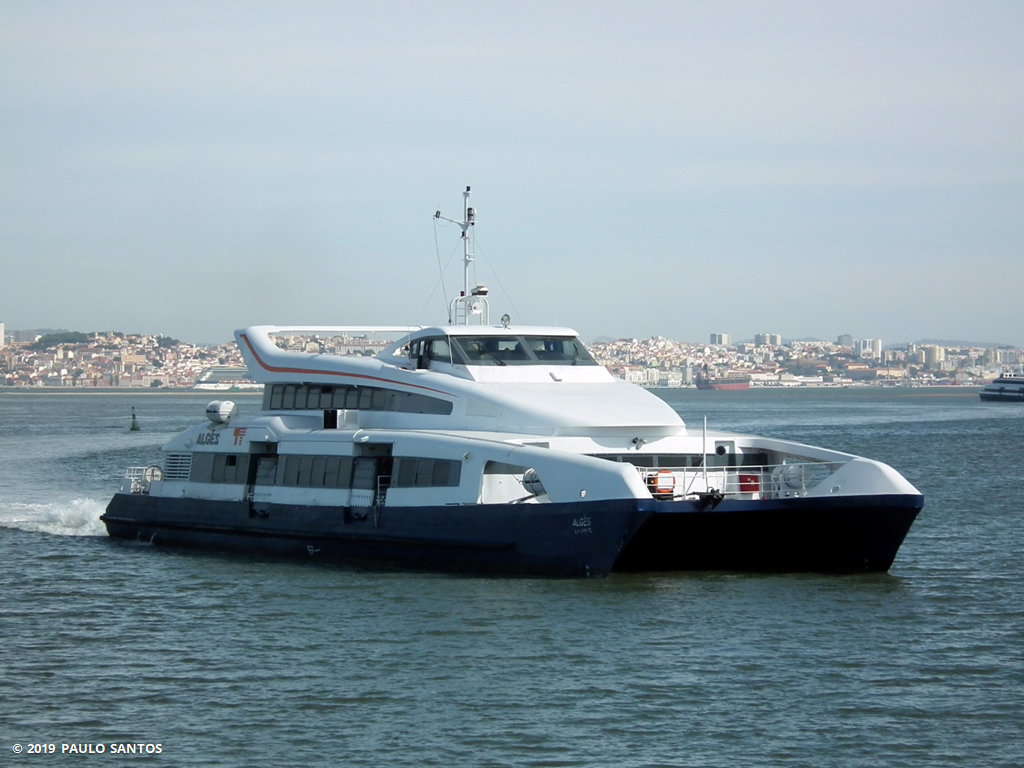
Ferry operated by Transtejo seen on the Tejo River arriving at Terminal Fluvial do Seixal in July 2019. This ferry of the catamaran type, named "Algés" and registered LX-3168-TL, is an FBM Marine TransCat completed in 1995, yard number 1422. Aluminum hull and superstructure. It has an overall length of 147.6 ft and can accommodate 496 passengers (496+4). Fainsa Arianne seats. It uses two 960 kW (1287 hp) Deutz MWM TBD 616 V16 main engines and two Lips water jets, and can operate in just 6.6 ft of water. Service speed is 22 knots. Its class includes four vessels – "Algés", "Castelo", "Chiado" and "Bica". "Algés" and "Castelo" are designed and built in the United Kingdom by FBM Marine ¹ . "Chiado" and "Bica" are built under license in Portugal by Estaleiros Navais do Mondego ² . Similar in appearance, vessels from the "Algés" class are shorter and less powerful than those in the ...
Light rail vehicle operated by MTS seen at Jardim da Quinta da Água, Corroios, in March 2026. This light rail vehicle with fleet number C006 is a Siemens Combino Plus completed in 2005. It features a four-section articulated body and low-floor. With an overall length of 119.3 ft, it can accommodate 74 seated passengers and 237 standees (74+237+1). SKA seats. Bi-directional operation. Fed via pantograph by 750 V DC, this light rail vehicle uses six 100 kW (136 hp) traction motors. Wheelset arrangement is Bo'Bo'2'Bo'. Track gauge is 4 ft 8 ½ in. Top speed is 43 mph. As a note of interest, the Combino uses independent wheels driven by motors and transmissions mounted longitudinally on the outer faces of the Siemens SF 30 bogies, one set for every two drive wheels. This technical solution allows for a lowered floor along the entire length of the vehicle. Based in Seixal, MTS, or Metro Transportes do Sul , operates regular services on its surface metro system serving th...
Bus operated by Carris seen on Rua Marquês de Fronteira, Lisboa, in January 2020. This bus with fleet number 1630 is a CAMO Camus VL registered in 2000 and included in a series of 35 units, 1601–1635, placed in service in 2000–2001. It has an overall length of 39.2 ft and can accommodate 30 seated passengers and 55 standees (30+55+1) ¹ . Esteban seats. It uses the Volvo B7L chassis with the 184 kW (250 hp) Volvo D7C engine. Established in 1872 and based in Lisboa , Companhia Carris de Ferro de Lisboa, whose name is usually shortened to Carris, operates regular services, regular specialized services and occasional services. Here, we see this CAMO Camus VL on regular service 742, B.º Madre Deus (Escola)–Casalinho da Ajuda. Produced from 2000 to 2006, the Volvo B7L chassis succeeds the Volvo B10L and precedes the Volvo B9L. It is used on low floor buses, double-deck buses, and articulated buses. It features the Volvo D7C engine mounted vertically on the left side at the rear end...



Comments
Post a Comment